
 Sète isn’t a renowned global tourist hotspot, but a small, port city surrounded by canals and a large bay on the Mediterranean.
 It calls itself the little Venice of the Mediterranean. I didn’t go there because of that, but I was on another food quest for its succulent orange crimped pastries, the famous Tielles.
I also knew that I could feast on seiches, the larger cousins of those marvellous chiperons I craved in Biarritz.
Perhaps only fellow foodies can understand how my culinary interests are a major guide to where I choose to go, besides art and history, of course.
Fortunately, almost everywhere in France has plenty of history and highly sought-after regional specialities and wines. Deciding where to go is difficult at best!
Most French people associate Sète with being the birthplace of the revered singer-composer George Brassens, who has a park named after him in Paris.
Sète lies about 25 kilometres south of Montpellier and is popular enough to have a direct TGV train from Paris, a short 3-hour, 45-minute ride.
It is surrounded by water. A larger section and the smaller island, crossed with canals, where I stayed.
European fast trains make travelling so much less of a hassle than flying, but are not less expensive! I enjoy the many colourful passing landscapes, such as these colza flowers in bloom.
Since many European airlines are now cutting routes due to jet fuel shortages, I noticed trains are filling up quicker than usual.
My mid-April trip started with a blustery, rainy arrival, which I consoled myself by delighting in delicious seiches à la placha smothered in a redolent garlic persillade.
Garlic is done with a major G here and is predominant and liberally used in Occitanian regional cookery. Much more heavy-handed than in Provence.
Sète is located at the upper reaches of the Languedoc-Roussillon coast, in Occitania, a huge swath of land in South-west France on the Mediterranean coast. .
A little bit of history. This area of France is as culturally and linguistically different from France proper as is the Atlantic Basque coast I wrote about in my last post.
The Occitan language is Latin-based and still spoken to a limited degree in coastal areas of this department. From it came the elegant, noble romance poetry of the Troubadours in the Middle Ages. It is also Cathare country.
Further down the coast, Catalan, the sister dialect, predominates and is the official language of the principality of Andorra, located on the Pyrenean border of France and Spain.
The delicious Tielles Setoise is an octopus or calamari-filled tourte that originated from a beautiful Italian port city, Gaeta, north of Naples. There, it is called a Tiella!
It was carried over by Italian immigrants from 1870, whose later generations dominate Tielles making today, offering some filled with mussels or vegetables like eggplant.
The Italians also brought over the concept of macronades, or pasta with meats or seafoods, and brageoles, or beef stuffed bracioli.
Escaping the prevalent dire poverty of the area, along with Sicilians, many came to Sète, where it is said a third of the population has Italian roots.
The first thing that I noticed upon arrival was the heavy accent associated with the area. It was comprehensible to my Parisian-acustomed ears, but there were some lapses.
I could see part of the Étang de Thau from my balcony and had hopes of taking in a thermal bath located there, but it was open only to official curists and temporarily closed to spa seekers.
The étang is also an oyster and mussel park where Italian immigrant fishermen lived in colourful little houses, seen today.
Sete is a working commercial port where red tuna fishing is a major industry. They even have a small tuna museum, the Tunoscope.
Besides its large tuna fishing fleet, it has ferries to Corsica, Sardinia, Majorca, Algeria and Morocco.
There is a squadron of tuna police who mount boats coming in, commercial or leisure, to inspect the amount of tuna caught.
Tuna is the most regulated species in the Mediterranean, with hefty fines awaiting those caught outside of legal limits.
Seen here are the underbellies of monkfish, with their livers, also a prized delicacy, on display to assure buyers of their freshness.
Monkfish is the most popular fish for bourrides, a delicious fish stew with vegetables thickened with lots of aromatic garlic aioli that whitens the sauce. Seiches, the white cuttlefish, is also used for tomato-based rouilles.
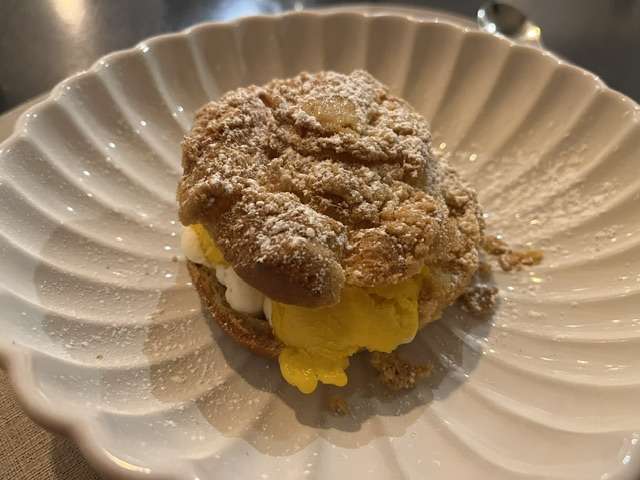
La Marine offered a redolent monkfish bourride. La Table de Laura; I indulged in a plump seiche perseillade, preceded by a wonderful raw tuna tartare and mango Paris-Brest, for dessert. 


At the Sète Les Halles, checking out local seafood, I treated myself to a piping hot out-of-the-oven tielle at Gianni Marcos.
Sitting on a bench, I gently pried open my paper-wrapped treat, nibbling ever so carefully the Tielle, so as not to spill the rich red sauce on my clothes.
However, a few minutes later, a woman came over to inform me that I had a large splotch of tomato sauce on my blond strands. Wiping it off was totally ineffective,  leaving a
  lovely rust-red stain that looked like I had tie-dyed hair!

I didn’t climb the adjoining high St Claire hill, topped by another lighthouse; instead, I opted for a boat tour of the canals, the étang of Thau and the open Mediterranean.
Before I left, I bought several Tielles from various confectioners and Zézettes de Sète, their special cookies to take back. Instead of a direct train this time, I took a regional one to Gare Montpellier St Roch to catch the TGV  back to Paris.
This cute little pigeon on the adjoining table kept a keen eye on me for any crumbs while grabbing a quick lunch.
A few bites of a huge, crunchy, sugar-dusted oreillette didn’t disappoint pigeon friend nor me! Another example of culinary exchange from my home state.
Yes, one can occasionally find a smaller version in Cajun country back in Louisiana. Called oreilles de cochon, or pig ears, they were brought over by French immigrants. There they are doused with pecans, bourbon and dark sugar cane syrup.
Sète is a perfect example of how culinary immigration from one country to another can optimise the native cuisine with dishes that become emblematic of their new place, like macronades and Tielles.
If you go, you can’t go wrong with Tielles from Giuletta, Cianni Marcos, Sophie Cianni, and La Cettoise. Just try not to stain your clothes or hair with the rich red sauce!
Discover more from A Psychotherapist in Paris
Subscribe to get the latest posts sent to your email.