
A replica of the Statue of Liberty, seen behind me, on Île aux Cygnes, took on a more sobering meaning for this American last weekend. I had just enjoyed a lovely dinner on a restaurant barge along the banks of the Seine in the shadow of La Tour d’Eiffel.
This universal symbol of America, a gift from France, has been an icon of freedom, whose torch, a beacon of hope, has welcomed millions of immigrants fleeing oppression, poverty, and violence from their country of origin.
Monday, the 14th, France celebrated Fête de la Bastille. This commemorates two historical events: the fall of the Bastille, a hated royal prison and symbol of its despotism, in 1789 and the first Fête de la Fédération in 1790. Freedom from any hint of heavy-handed authoritarian/monarchical type rule is still feverishly defended in France.
It was not surprising that in 1886, the French, having been involved in helping America win its Independence, wanted to gift the emerging country of America with a beautiful symbol of liberty in honour of the Centennial of American Independence, the magnificent Statue of Liberty. It has graced New York City’s harbour for 139 years.
Certainly, Lady Liberty’s torch was a welcome sight that greeted a paternal great-grandfather, who sailed into New York harbour from Ireland, as it would be for millions of other Americans’ ancestors from across the sea.
Sadly, that is no longer the case. Her torch of liberty has been diminished. Beloved America, the once sought-after land of the  free, whose torch of liberty welcomed the poor and oppressed, is today persona non grata for those seeking refuge.
The whole idea of gifting a commemorative statue to honour the centennial was the brainchild of Édouard René de Laboulaye, a French senator.
He was an ardent admirer of the US Constitution and championed the Union’ s effort to abolish slavery during the Civil War. He was so impressed by American democratic ideas that he even wrote a multi-volume tome in praise of American democracy. His love of America inflamed his passion for freedom.
In 1865, he sought out his friend, Frédéric Auguste Bartholdi, a prominent French sculptor from Alsace, to design the massive sculpture. Bartholdi turned out to be the perfect choice for this monumental task. He, having been a soldier in the Franco-Prussian War, was consumed with thoughts of freedom, wanting to liberate his natal Alsace, which ended up being annexed to Germany.
He had already designed an archetypal draped figure holding a torch that was unsuccessfully proposed to the Egyptian government for the entrance of the Suez Canal.
Bartholdi, a Freemason, sailed to the shores of America in 1866 to scout out an ideal placement in New York City harbour. He decided that Bedloe’s Island, a former army fortress, would be the perfect spot to erect his immense statue.
It was approved and financed through various French funds. Bartholdi decided to make the statue out of layers of copper, but sought the help of Gustave Eiffel, who later built the Eiffel Tower, to help design the inner iron pylon and framework.
In 1886, the completed statue stood towering over the rooftops of Paris, awaiting being shipped to America. In order to get it across the sea, it was separated into 350 pieces and shipped in 214 crates on board the French naval ship Isère!
America agreed to fund and build the giant pedestal needed to support the statue. Joseph Pulitzer sought donations in his New York World newspaper, which resulted in over a hundred thousand dollars being raised.
Torches are meant to carry light or in popular vernacular, to proclaim a passionate feeling or thought. There are many torches one could carry today against the various injustices in this world.
In the past, I enjoyed voicing to Europeans the uniqueness of American society of being a multicultural melting pot whose constitution was founded by immigrants as a safe refuge for many searching for freedom to build their American dream.
Unfortunately, that uniqueness no longer holds precedence. The current aggressive and often violent hunting down of immigrants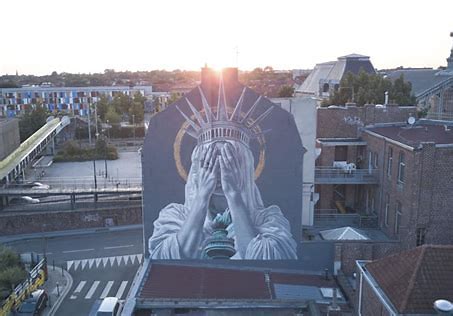 and mass deportations without due process guaranteed by the 5th and 14th Amendments warrants my and many others’ concern.
Lady Liberty’s welcoming light is now darkened. Dutch artist Judith de Leeuw recently unveiled her huge mural painting in Roubaix, France, depicting her shock and dismay, shared by many over the current immigrant situation in America, where human suffering is met with indifference rather than mercy.


Discover more from A Psychotherapist in Paris
Subscribe to get the latest posts sent to your email.


